|
 |
DiscoverCircuits.com -- Hobby Corner
Last Updated on:
Friday, September 20, 2013 05:49 PM
Hobby Circuits'
Category List
The contents &
graphics of Discovercircuits.com are copyright protected.
LINKING to Dave's circuits is permitted but DO NOT COPY any files to your WEB
SITE server |
|
|
|
More
Alarm
Circuits
Current Monitors
Testers |
|
Clip-on AC Current Indicator
Circuit
Pump Motor Monitor |
Several times over the last few years I have received calls from people looking for
a simple circuit that would tell them when a sump pump or water well pump motor was
running. These people told me that the electrical circuits that turn on and
off the motors were frequently inaccessible, often below ground, making it difficult
to know if the motor was running or not. What they wanted was a simple way to
let them know when the motor was on or off, without wiring something into the 120vac
or 240vac power supply. At the time I didn’t have a ready circuit for them but
I put the requirement into my subconscious and let my mind work on the problem for a
while. After some thought, I came up with the solution described below. |
|
|
| The
traditional method for determining if a motor is running or not is to measure the
current flowing through one of the wires supplying power to the motor. When the
motor is off, the current should be near zero and will jump to the running current when
the motor turns on. The classic sensor for measuring AC current is a current
transformer. In a typical AC current transformer configuration, one of the wires
carrying current to the motor would be routed through the transformer with the one wire
forming a single-turn primary. The magnetic field produced by the current flowing
through the wire induces a voltage in the secondary winding of the transformer,
proportional to the current. The output voltage of the transformer would then be
connected to a circuit, which would activate a switch, whenever current was drawn by the
motor. However, this single wire connection is often difficult and can be
dangerous for a novice to wire into an electrical system. The installer would have
to cut into the power cable to expose one wire or find an exposed single wire somewhere
else, perhaps inside the circuit breaker box. Clamping a typical current meter,
using a current transformer probe, over the whole three wire power cable will result in
a zero current reading, since the field produced by the return wire, which is also
inside the cable, will be canceled by the magnetic field of the supply wire. So,
how do you detect the current? The solution is to rely on the fact that the two
wires carrying current inside the cable are not perfectly in parallel with each other.
A small coil, acting like a transformer, placed against one wire, will pick up more of
its field and less from its neighbor. Although the signal produced by the coil
will be small, enough can be collected to indicate if the motor is drawing current or
not. When connected to a sensitive circuit, a simple monitoring device can be
produced. The user just has to find a suitable place to clamp the box containing
the monitoring circuit to the outside jacket of the power cable, supplying current to
the motor. |
|
|
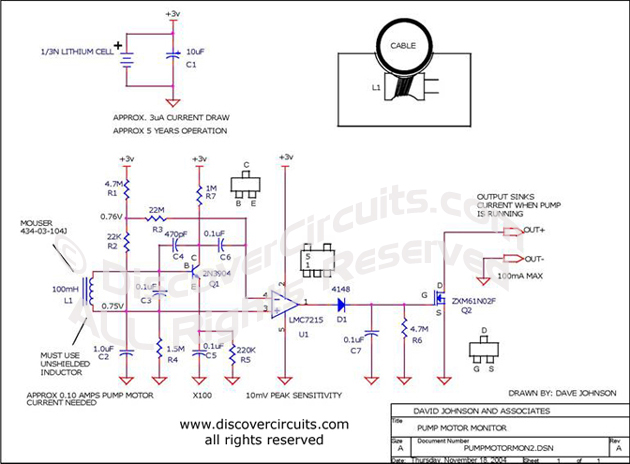
I chose to power the monitoring
circuit with a small battery. With a simple battery supply, there is less a user has
to worry about. Using modern components, I was able to keep the current
consumption to a very low level. A small 3v lithium battery cell will power
the circuit for about 5 years. The two wires connected to the circuit’s
transistor switch can be used to turn on a light or noise maker, located some
distance from the monitoring box. The
circuit uses a small unshielded 100mH inductor as a current transformer. The
voltage generated by the coil is fed to a single transistor circuit, which is
configured as a high gain, low frequency amplifier. The circuit has a gain
over 100. The output of the amplifier is connected to a voltage comparator.
The DC bias voltages at the input of the comparator set the sensitivity of the
signal from the amplifier at about 10 millivolts. |
|
| This
should be sufficient for most applications. If the coil is placed properly against
the outside of the power cable, a current of 100ma AC should be sufficient to activate
the circuit. The output of the comparator is a pulse train equal to the 50Hz or
60Hz power line frequency. A simple diode rectifies the pulses and produces
sufficient DC voltage to turn on the transistor Q2. The transistor acts as a
switch, which closes when the circuit detects motor current flowing through the power
cable. |
| If
the user wishes to power an indicator light from the same 3 volt battery, he should use
a flashing LED circuit, such as the one shown below. This type of circuit will not
tax a small battery. Of course, the user can increase the battery size if desired.
The circuit will work fine from two 1.5 volt AA cells. |
|
|
Click on Drawing Below to view PDF version of Schematic |
|
 |
|
|
|
More
Alarm Circuits
Current Monitors
Testers
Hobby Circuits'
Category List
eMail David A.
Johnson, P.E. about this circuit |
|
|

 Custom Search