DiscoverCircuits.com, has 30,000+ electronic
circuits, cross-referenced
into 500+ categories. We have searched the web to help you
find quick design ideas.
We make every effort to link to material posted by the designer.
Please let us if you would like us to link to or post your
design.
12v Battery Load Cutout Circuit --
August 23, 2009
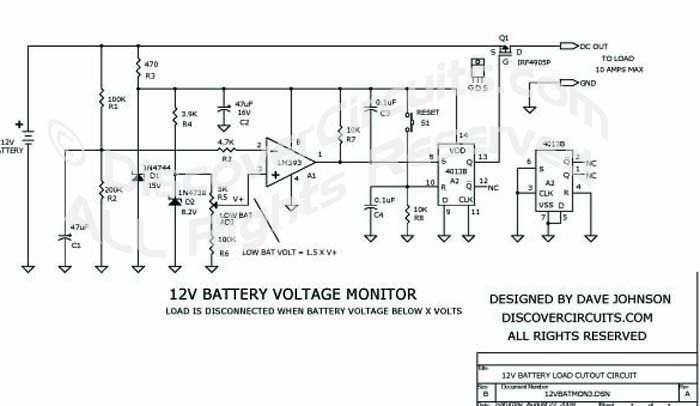
Lead-acid batteries should not be
discharged below a certain point if they are to last. Also, you don’t want certain
12v powered devices, which might be plugged into a car’s cigarette lighter outlet, to
drain the car battery down to a point where the car’s engine will not start. To
prevent battery damage or a dead battery, the circuit below disconnects a load from the
battery when the voltage dips below a fixed but adjustable voltage and will not
reconnect the load until a reset button is pressed. To keep the whole circuit
efficient and compact, a medium current rated p-channel FET forms the power switch.
A 8.2v zener diode forms the voltage reference while a second 15v zener diode acts as a
transient voltage protector.
The circuit uses one half of a popular
LM393 dual voltage comparator to monitor the battery voltage and the adjustable reference
voltage. If the battery voltage drops below the adjusted level, the comparator changes
state. One half of a popular CD4013 dual flip/flop latches the on/off condition.
A reset button must be pressed to reestablish power to the external load.
A rather
long 5 second time constant filter is used in the voltage comparator circuit. This
allows the circuit to ride out the dip in battery voltage, which always takes place when the
car’s engine is started.
Click on
Drawing Below to view PDF version of Schematic