|
Circuits designed by David Johnson,
P.E.
Last Updated on:
Saturday, December 23, 2017 03:21 PM
Master Category List - Dave's Circuits
The contents &
graphics of Discovercircuits.com are copyright protected.
LINKING to Dave's circuits is permitted but DO NOT COPY any files to your WEB
SITE server |
 |
|
|
|
|
|
|
More
LEDs
Flasher |
|
High Power
LED Flasher
August 3, 2008
|
|
Power LEDs are becoming more popular these days. The DC input power to these
devices ranges from 1 watt to 5 watts. Normal LEDs only receive about 0.05
watts. At this higher power, these devices can emit a lot of light.
You can buy them in just about any color in the rainbow but white seems to be the
most popular. One application for these devices is a flashing light.
If the flash duration and flash rate is kept low, the average current can be low
enough that even a small battery can last quite a while. |
|
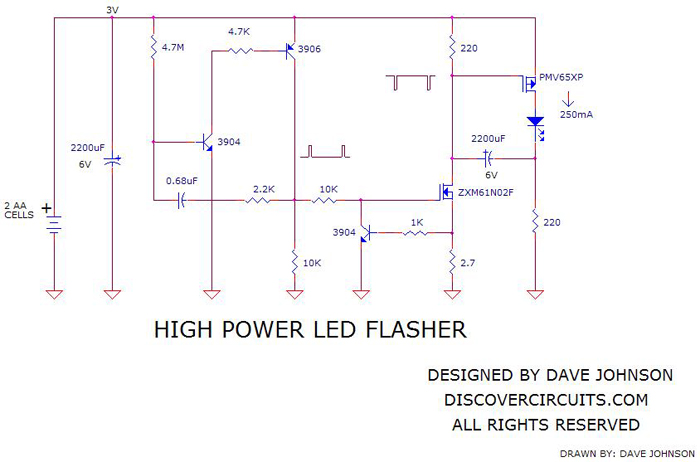
The circuit below is designed to
power any 1 to 5 watt power LED. It is designed to run from a +3v supply, which
includes two standard alkaline or NiMH
AA cells. It uses a charge pump method to
provide the higher voltage needed by white and blue LEDs. It also has an active
current liming circuit, set for 250ma. This is sufficient current to produce an
intense light flash. |
|
The circuit uses a classic two
transistor oscillator to produce the pulse train. With the components shown, the
circuit generates a 20ms pulse at a frequency of about 0.5Hz. The 2.7 ohm
resistor sets the LED pulse current at about 250ma. The average battery current
is only 1.3ma, so a pair of standard AA cells should power the flasher for about one
month. This intensely bright flasher might uses in warning lights and might
be great for those who ride their bicycle at night. The intense bright flashes
are impossible to miss at night. |
|
|
Click on Drawing Below to view PDF version of Schematic |
|
 |
|
|
|