|
 |
Circuits designed by David Johnson, P.E.
Last Updated on:
Monday, December 25, 2017 02:09 PM
List of Dave's Circuit Designs
The contents & graphics
of Discovercircuits.com are copyright protected.
LINKING to Dave's circuits is permitted but DO NOT COPY any files to your WEB
SITE server |
|
|
|
|
More
Alarms;
Power Line Circuits Unplugged Appliance Alarm I got a call from an
administrator at a large prison. He told me that he was having problems with
inmates who keep unplugging refrigerators, vending machines and microwave ovens in a
commons area. He wanted a battery-powered device, which could be mounted to the
outside of the power cord of an appliance. The device would produce a loud alarm
whenever the power plug of the appliance was unplugged from a power outlet. He
said that the prison had an emergency backup generator, so if utility power were lost;
their generator would kick in within a minute or two. He therefore did not need
any automatic timeout after the alarm started. I gave this some thought and came
up with the circuit below.
|
|
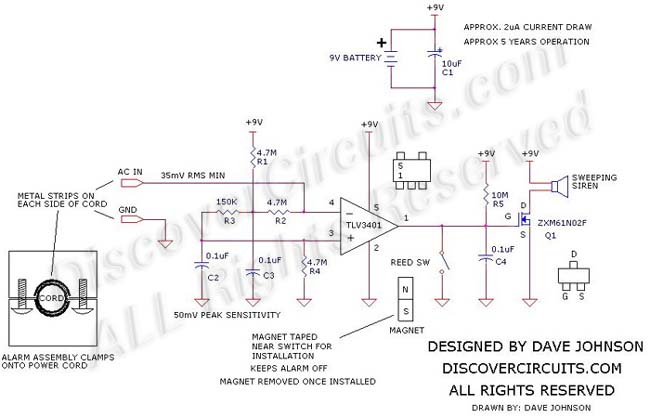
| A 9v battery
powers the circuit below. Its standby power is so low that a 9v battery should last
5 years or so. A pair of copper strips pushed onto the surface of the power cord by
the “clamshell alarm assembly” collects a tiny bit of voltage from the electric field
emitted by the power line through capacitance coupling. A low power voltage
comparator converts that voltage into a square wave signal. The open drain output of
the TLV3401 comparator from Texas Instruments keeps the capacitor C4 discharged, when the
circuit detects AC from the power cord. When the AC power is lost, the capacitor C4
is charged up through R5 and turns on the transistor Q1. Q1 then turns on the alarm.
A piezoelectric siren with a sweeping tone is recommended as the alarm sound generator.
Note that the circuit will not go into alarm if the appliance is turned off, since AC
would still be present in the power cord. Only when the plug is removed from a power
outlet will the device go into alarm. I also show how to use a small reed relay in
the circuit during installation. By taping a magnet near the switch, on the outside
of the plastic alarm enclosure, the alarm will be kept off. |
| |
|
Click
on Drawing Below to view PDF version of Schematic |
|
 |
|
|
|
|
|
|