|
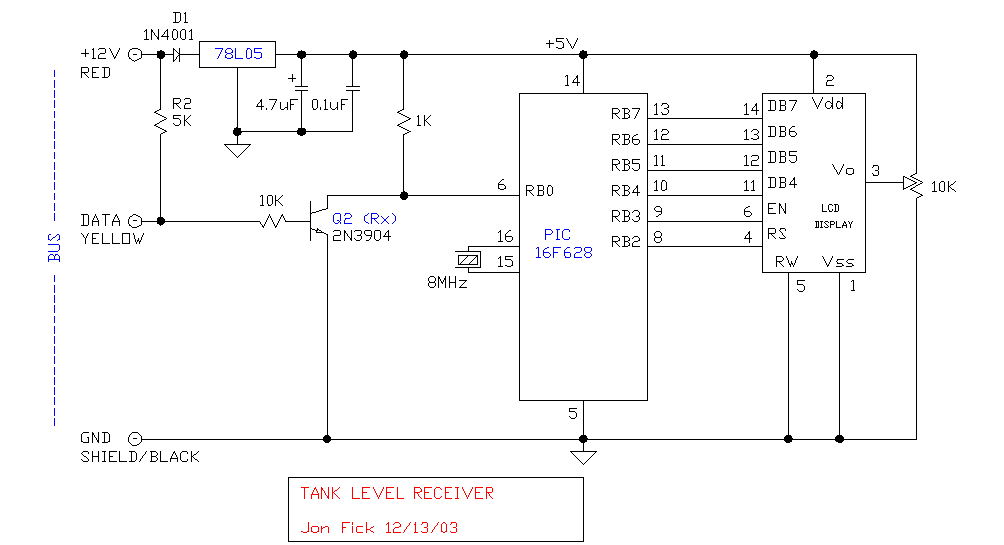
Liquid Level Receiver - Schematic __ Designed by Jon Fick
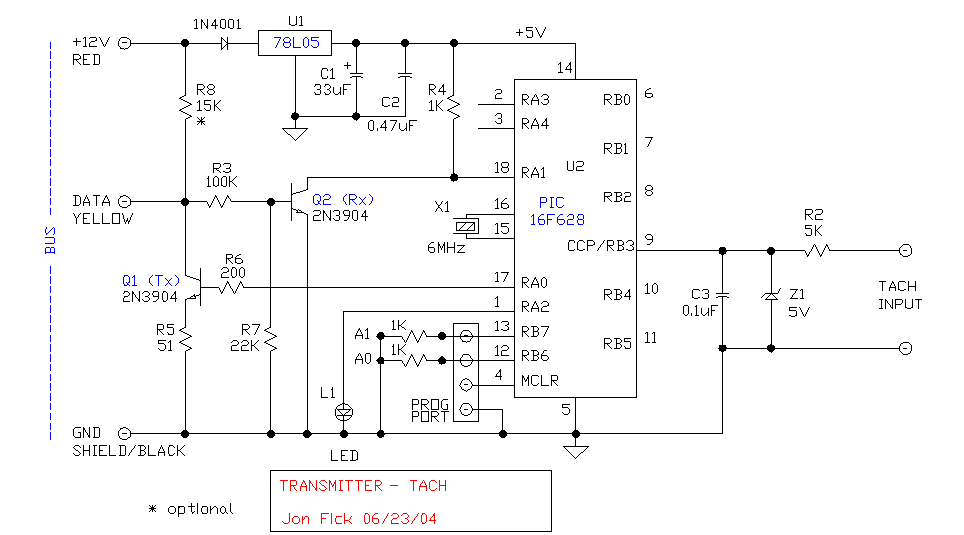
Liquid Level Transmitter/Receiver SystE - M - designed for marine applications using raytheon's seatalk®bus. Includes tachometer transmitter example although the receiver is only for liquid level (16f628) __ Designed by Jon Fick
Low Value Capacitance Meter - This circuit was originally designed to measure the volume of fluid inside a medical syringe. As designed, it produces a zero to 5 volt output, corresponding to a capacitance change of about 10 picofarads. . . Circuit by David A. Johnson P.E.-December, 2004
Plant Moisture Monitor - Originally intended to monitor the moisture in a potted plant, this moisture monitor really shines as a Christmas tree stand water level monitor! A fresh Christmas tree drinks water an annoying rate and bending down under the __ Contact: Charles Wenzel of Wenzel Associates, Inc.
Plant Power - All plants carry an electric charge relative to the ground. This charge is more or less constant regardless of the size of the plant a kind of background voltage" in nature. This electric charge suffuses the entire plant, from its roots to its leaves and fruit. It was measured between a chrome-plated pin inserted into the plant __ Designed by Rev. Thomas Scarborough
Plant Watering Watcher - A flashing LED signals the necessity to water a plant; Very low current consumption3V powered circuit __ Contact: Flavio Dellepiane, fladello @ tin.it
Plants Watering Watcher 2 - IC1D is a CMOS
Schmitt trigger oscillator at about 2KHz. It starts and continues to oscillate with a supply down to 1.24V (the lowest output voltage of my LM317 variable power supply) or less; IC1A is an inverter; IC1B is a Schmitt trigger NAND gate. Its output is low only when both inputs are at, or higher than the upper Schmitt trigger threshold voltage. With 47 ohms or less between the probes, an input is always low, so the output is always high. __ Contact: IQ Technologies
Precision Low Capacitance Meter - This circuit was originally designed to measure the volume of fluid inside a medical syringe. As designed, it produces a zero to 5 volt output, corresponding to a capacitance change of about 10 picofarads . . . Hobby Circuit designed by David Johnson P.E.-December, 2004
Sonarlike method Detects fluid level - 07/19/01 EDN-Design Ideas Figure 1 illustrates a simple, cost-effective method of measuring the height of fluid in a column by using ultrasonic waves. Two piezoelectric transducers generate and listen to the ultrasonic acoustical wave. First, the transmitter piezo element receives stimulation from a square wave that lasts three or four cycles__ Circuit Design by Robert LeBoeuf and Eric Masse, National Semiconductor, Salem, NH |