|
DiscoverCircuits.com -- Hobby Corner
Last Updated on:
Tuesday, June 01, 2021 03:06 PM
Hobby Circuits List
The contents &
graphics of Discovercircuits.com are copyright protected.
LINK to Dave's circuit, but DO NOT COPY any files to your WEB
SITE server |
 |
|
|
|
|
|
|
More
Voltage Converter;
Flyback Converter
|
|
Voltage Converter 0.5v to 6v |
Conventional silicon transistors just
can't operate at voltages less than about 0.7v. Old germanium transistors could be
used, but those are hard to find these days and most are rather large in size. Some
new n-channel MOSFET devices with very low gate-source threshold voltage can operate
at quite low voltages. I've been experimenting with various devices and came up with
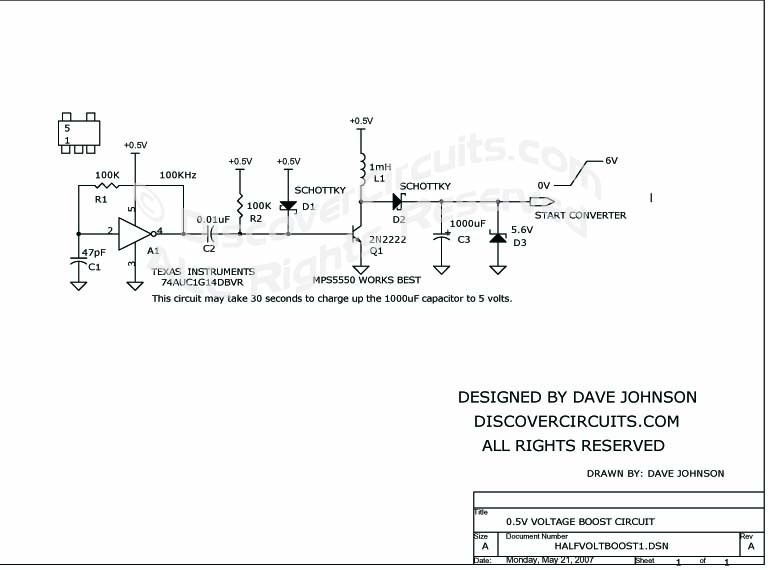
one electronic circuit (shown below), which demonstrates how to boost the low
voltage from a single solar cell to a higher voltage. |
|
| The key component in the circuit
below is a cheap single logic device from Texas Instruments. It turns out that
TI's 74AUC family of parts can work down to about 0.45 volts. I tried one of their
single schmitt trigger parts and found I was able to make on oscillator function
nicely at 0.5 volts. I then used a charge pump technique and a cheap NPN
transistor to form a low power flyback converter. This hobby circuit can produce
about 6 volts at the output from a 0.5v input.
The idea is to use this boost circuit to generate
the higher starting voltage needed by a much more powerful DC to DC converter.
Once started, part of the converter's output could then be feed back to the input,
to sustain converter operation. This is known as a "bootstrap" technique. In the
future, I hope to post a circuit which can supply several watts of power from a
0.5v input voltage. This would be ideal for charging a battery using power from a
single large solar cell or several smaller cells wired in parallel.
|
|
|
|
|
Click on Circuit Below to view PDF of Schematic |
|
 |
|
|
|
More
Voltage Converter; Flyback Converter
Hobby Circuits List
eMail David A.
Johnson, P.E. about this circuit |