|
DiscoverCircuits.com -- Hobby Corner
Last Updated on:
Tuesday, June 01, 2021 03:06 PM
Hobby Circuits List
The contents &
graphics of Discovercircuits.com are copyright protected.
LINK to Dave's circuit, but DO NOT COPY any files to your WEB
SITE server |
 |
|
|
|
|
|
|
More
Motion
Detectors |
|
Shadow Activate Motion Detector
|
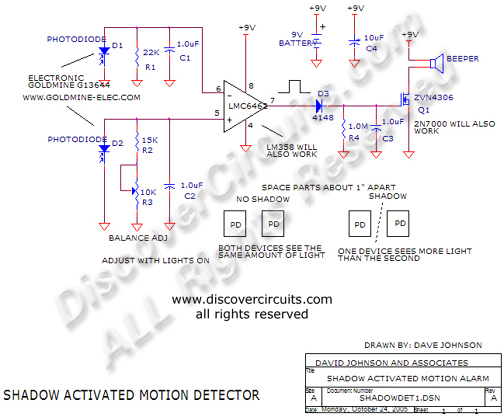
There are many ways one can detect nearby human or object motion. This
circuit demonstrates one way. It detects motion by noting the changes in the
shadow cast by the moving object. |
|
| The
hobby circuit below works quite well in typical indoor room lighting. I would not
recommend its use in direct sunlight. Two small PIN photodiodes positioned about
one inch apart form a shadow detector. With no shadow cast on the devices, both
devices produce nearly identical current levels. The current is converted to a
voltage with a load resistor in parallel with the photodiode. One resistor is
adjustable so the two voltages can be carefully balanced under uniform lighting.
When a hand or an arm is moved over the sensors, casting a shadow, one device will
detect more light than the second. This triggers an imbalance. |
|
A voltage comparator connected to the two devices
detects the imbalance and sends a high logic level signal to an n-channel FET, which
can turn on a beeper or activate a relay. If a low power voltage comparator is
used, such as the LMC7211, a 9 volt battery will power the electronic circuit for
many years. The more popular LM358 would also work but would draw more
current. Click below to see a short movie (MPG File) of the device in action.
Demonstration AVI Files
(Double Click on the above link to view movie)
|
|
|
|
|
Click on Circuit Below to view PDF of Schematic |
|
 |
|
|
|
More
Motion
Detectors
Hobby Circuits List
eMail David A.
Johnson, P.E. about this circuit |