|
DiscoverCircuits.com -- Hobby Corner
Last Updated on:
Tuesday, June 01, 2021 03:06 PM
Hobby Circuits List
The contents &
graphics of Discovercircuits.com are copyright protected.
LINK to Dave's circuit, but DO NOT COPY any files to your WEB
SITE server |
 |
|
|
|
|
|
|
More
Solar Cell Circuits |
|
Solar Insolation Monitor
designed
by David Johnson, P.E.
(5/1/2012) |
| Owners of photovoltaic
solar panels often like to monitor how bright the sunshine is. They can use this
information to gage how well their solar panels are doing. On a typical clear day,
the sun energy at sea level is about 1000 watts per square meter. But, a tiny bit of
haze or smog can reduce the available energy. One way to monitor the amount of
available sunlight energy is with a solar isolation monitor. Commercial devices can
cost an arm and leg. You can build your own unit for a lot less. The hobby circuit
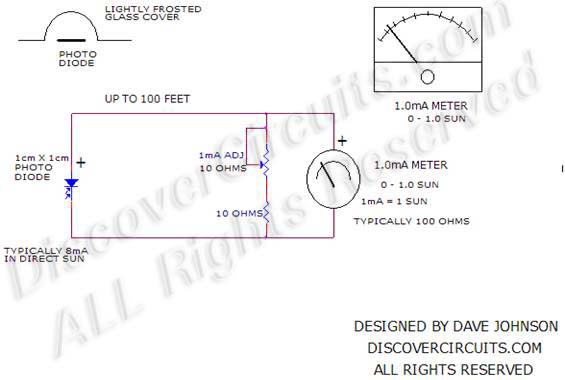
below does not require any power. It uses a quality 1cm X 1cm PIN photo diode as the
sunlight detector. Digikey sells a nice one for about $11. Their part number is
PDB-C613-2. |
|
| The
photo diode acts as a small low leakage solar cell and produces a current proportional
to the sunlight intensity. To protect the photo diode from the weather, it should be
housed in the left of a one inch diameter thin glass hemisphere. A light frosting on the
inside of the glass will diffuse the light enough to obtain a uniform measurement, even
as the sun moves from East to West. For best results, the left axis of the hemisphere
should face due South at a 45 degree angle here in the US. The meter can be located some
distance from the solar sensor. You should be able to use 18ga or larger two conductor
“zip” cord, which is often used on AC powered lamps and appliances. |
|
|
The 10 ohm variable resistor in the electronic circuit
adjusts the meter readout for 1 milliamp of current with a 1 sun condition. A
professional solar insolation meter can be used as a calibration tool. Otherwise,
you can just adjust the meter for a full scale reading, when the sun is directly
overhead on a very clear day. If you prefer a digital readout, you can replace the 1
milliamp meter with a 100 ohm 1% resistor. At a one sun condition, the voltage
across the resistor would be 100 millivolts. Any digital panel voltmeter will then
read 100.0 millivolts at one sun. |
|
|
|
|
|
 |
|
|
|
More
Solar Cell Circuits
Hobby Circuits List
eMail David A.
Johnson, P.E. about this circuit |
|
|