|
DiscoverCircuits.com -- Hobby Corner
Last Updated on:
Tuesday, June 01, 2021 03:06 PM
Hobby Circuits List
The contents &
graphics of Discovercircuits.com are copyright protected.
LINK to Dave's circuit, but DO NOT COPY any files to your WEB
SITE server |
 |
|
|
|
|
|
|
More
Oscillator Circuits |
|
Very Low
Voltage Oscillator Circuit
February 8, 2007
designed
by David A. Johnson, P.E. |
| OK, you may not ever need
an oscillator to function using a power supply voltage below one volt, but if you
ever do need one, here is one way to do it. |
|
|
Getting any
electronic circuit to operate below one volt is a real challenge. Typical silicon
bipolar transistors don’t work below 0.7 volts. Some old germanium transistors do
work down at low voltages but those are hard to find and are usually offered only in
large packages. |
|
Why operate below one volt? Many energy
harvesting systems generate low voltages. Fuel cells, vibration transducers,
thermoelectric devices, RF detectors and photovoltaic cells all will typically
produce low voltages. A single solar cell will only produce 0.5 volts.
This is well below any practical voltage, so some type of DC to DC converter would
be needed, to boost the voltage to some reasonable level to perhaps charge a
battery. At the heart of any DC to DC converter is an oscillator. If you can’t
run an oscillator with the available voltage, you will never be able to boost that
voltage to a higher one.
I gave some thought about the various
ways one could design a low voltage oscillator. After doing some research, I
decided to try some new zero threshold voltage n-channel FETs from Advanced Linear
Devices (www.aldinc.com). |
|
|
|
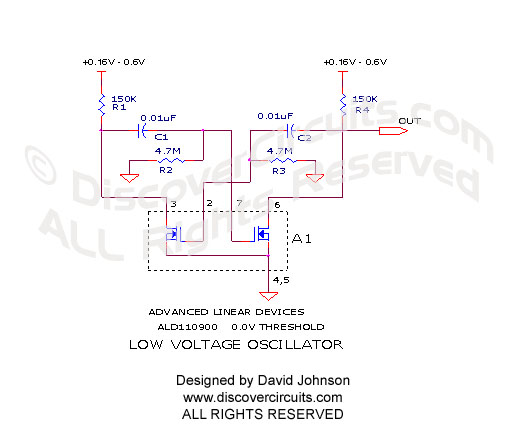
These devices come two transistors in an 8 pin package, with a common source
connection. I wired up one of their devices as a classic two transistor astable
multivibrator circuit. By carefully picking the component values, the circuit
operates from about 0.16 volts to over 0.6 volts. The circuit below generates a
nice square wave signal with a frequency of about 300Hz. A higher frequency is
possible by changing the two 0.01uF caps to smaller values. |
|
|
Click on Circuit Below to view PDF of Schematic |
|
 |
|
|
|
More
Oscillator Circuits
Hobby Circuits List
eMail David A.
Johnson, P.E. about this circuit |