|
A repetitive trigger - Based on the 555 timer IC, useful for strobe lights. A bit on the 4017 counter IC for multiple flashes and sequences of flashes __ Designed by Don Klipstein A Simple Circuit light flashing - This circuit use 2 transistor and some components.
AC Line Powered LED Flasher - Some of the latest LEDs are amazing. They can produce a surprising amount of light with very little current. In the light flasher application shown below I take advantage of a nice surface mounted LED from King Bright. This flasher circuit draws only about 3ua of average current from the AC power line to flash this green LED. This flasher might be used as a power indicator light . . . Hobby Circuit designed by Dave Johnson P.E.-December, 2008
Adjustable Strobe Light - This Adjustable Strobe Light is the bigger brother of the plain old strobe light. This one uses a much more powerful "horse shoe" Xenon tube which produces more light. You can also control the flash rate up to about 20Hz. Do not look directly at the flash tube when this thing is on! __ Designed by Aaron Cake
Advertising Badge #1 with Flashing LED - I have seen numerous flashing light badges at trade shows and conventions. They are often handed out as gifts to promote some business. The devices often use inefficient circuits, which cause the battery power source to be quickly depleted. . . Circuit by David Johnson P.E.-March, 2002
Advertising Badge #2 with Flashing LED - This circuit uses a CD4013 dual D Flip/Flop IC. A single lithium battery will provide months of continuous LED flashing. It also has a tiny push-button switch to turn on and off the light flashing. . . Circuit by David A. Johnson P.E.-March, 2002
Alternating Flashing Light - This project is best for mounting on a layout to light a crossing or ring a bell. __ Designed by ML Rollins
Alternating LED flasher uses minimal parts - 11/20/97 EDN-Design Ideas A pair of alternating flashing LEDs makes an excellent visual alarm, this alternating LED flasher is based on one LED with built-in flashing function and two transistors driving or normal LED. Design by Dennis Eichenberg, Parma Heights, OH
Alternating LED blinker uses four parts - EDN-Design Ideas March 26, 1998 [ NOTE
: File has multiple design, scroll for this one.] The circuit in Figure 1 is an easy-to-make attention-getter and runs for a week or longer on two AA cells. In September, I used this circuit for a school fundraiser, and it helped me generate more than $100. My dad showed me a circuit in EDN that did the same thing, but it uses more parts (see "Alternating LED flasher uses minimal parts," EDN, Nov 20, 1997, pg 104) . Design by Andy Meng, Cincinnati, OH
Alternating LEDs Flasher - Classic astable multivibrator using 2 transistors. Transistor is not critical. Try these: 2N4401, 2N2222, NTE123A, NTE123AP, NTE159, TUP/TUN and those in your junk box, you may find that most of them will work. __ Designed by Tony van Roon VA3AVR
Amplifier for a Xenon Lamp Flash Detector - This circuit has a very low standby current requirement yet has very high sensitivity toward the light flashes from a xenon lamp. When connected to a flip/flop it can serve as an on on/off Controller. . . Circuit by David Johnson P.E.-February, 2002
An LED Flasher with a SlowRise & Fall Time - Here is a Simple Circuit to give a Flashing LED, With a "Rising and Falling" Brightness. It Uses the Sawtooth waveform from pins 2 and 6 to create the rise and fall. The Resistor and LED on Pin 3 are Optional. The 10K Potentiometer give a reasonable range of Speed. __ Designed by G.L. Chemelec
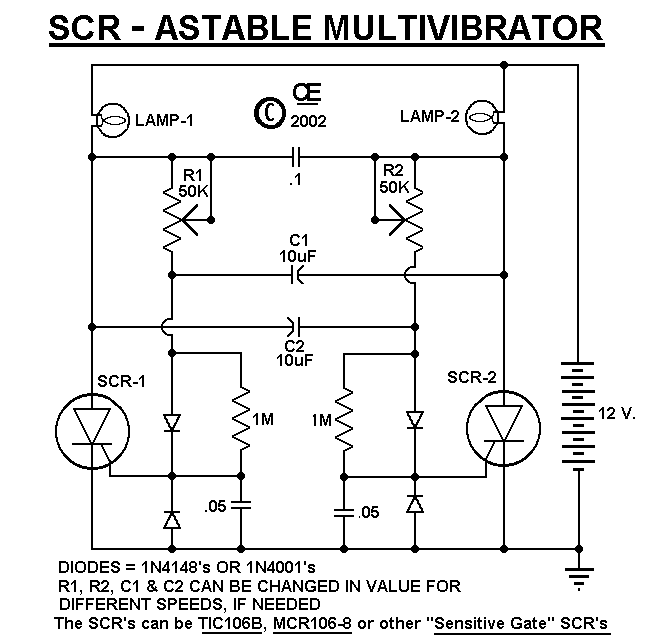
An SCR Flipflop for Alternating Flashing Light Bulbs - Schematic only __ Designed by G.L. Chemelec
AN95Simple Circuitry for Cellular Telephone/Camera Flash Illumination: A Practical Guide for Successfully Implementing Flashlamps - Linear Technology AN95 __ Designed by Jim WilliamsMar 1st, 2004
Attention-Grabbing 'Blue Light Special' - 16-Mar-09 -Design News: William Grill wanted to draw attention to a trade show booth. He considered a big neon sign, loud music and a provocative attitude, but instead he created this attention-getting gadgethis "Blue Light Special." Grill made this gadget with a mere $15 in materials. It is built around Microchip __ Gadget Freak-Case #137
Automotive Trafficator - The last variant on the oscillator is a circuit I built up to replace the standard auto trafficator flasher. __ Designed by Richard Torrens
Back & Forth Flasher - for16 LEDs. __ Designed by Tony van Roon VA3AVR
Bar-mode LED-cluster sequencer - Bar-mode LED-cluster sequencer. Can drive up to 16 clusters. __ Contact: Flavio Dellepiane, fladello @ tin.it
Bar-mode Lights Sequencer - Can drive up to 15 LEDs or LED-clusters; Selectable Bar-length __ Contact: Flavio Dellepiane, fladello @ tin.it
Basic FlashLamp Illuminationry for Cellular Telephones/Cameras - DN345 Design Notes__ Linear Technology/Analog Devices
Basic LED flasher using NE555 timer IC - This circuit has a lot going for it. For one thing, it only consists of two transistors, two capacitors and four resistors. That also means it consumes very little power. You can control the flash rate by changing the size of the 100k resistors (100k makes for a pretty slow rate) . You can also control the duty cycle by using resistors of different values on the two sides __ Designed by Colin Pringle
Basic LM3909 LED Flasher - LED flasher with the LM3909 IC and runs from1.5-Volt battery. __ Designed by Tony van Roon VA3AVR
Battery Free LED Flasher - LED flashers have been used for a wide variety of applications. Some flasher units have been used in food and hardware stores, to draw attention to sale items and are often attached to boxes which dispense product discount coupons. . . Circuit by Dave Johnson P.E.-December, 2010
Battery-Powered LED Flashing Advertising #2 - This circuit is similar to flashing LED advertising badge #1. It uses a CD4013 dual D Flip/Flop IC. The 74HCT74 IC in #81 does not always work. As in #81, a single lithium battery will provide months of continuous LED flashing. . . . Hobby Circuit designed by Dave Johnson P.E.-March, 2002
Beat Tracking Strobe - Strobe lights have always been an integral part of dance parties, adding an additional element of excitement to the festivities on hand. The combination of flashing lights and music-especially those with a definitive strong beat- are a natural complement to one another, where the strobing of light is an extension and links one's aural perception to his visual senses. The applications of strobe lights are numerous. In more involved and comprehensive applications the strobe user would like the strobe to help fuse together the music and light. For our final project we opted to attempt to create such a strobe system appropriate for the more complex application by creating a light strobe system that flashes a light source directly in sync with the music in real time __ Designed by Chris Chan and Kenneth Liu
Bicycle back Safety Light - Flashing 13 LED unit, 3V supply; Also suitable for jogger/walkers __ Contact: Flavio Dellepiane, fladello @ tin.it
Bicycle rear flashing LED light - No circuit description, schematic only__ CdS Electronic
Bike Turning Signal - This circuit can be used to indicate left and right turn on a motor-bike. Two identical circuits will be needed, one for left and one for right. __ 555-Timer
Birthday Heart - This circuit was made for my wife's birthday. It is capable of flashing five strings of LED's with different frequencies. It also has a connector for an 8 Ohm loudspeaker and two connectors for the small PCB's that are contained in musical greeting cards. In this way the circuit will play alternatingly two room filling tunes at regular time intervals. After a w __ Designed by Michel Van den Bergh On Electronics
Blink a LED - For non-embedded programmers the first thing to try on a new system or in a new programming language is to print out "hello world". The equivalent for microcontrollers and other embedded systems is to blink a LED. When even the target circuit and the programmer are freshly put together it is wise to start even lower, with a blink-a-LED program written by someone else that is known to be working. Then when the LED does not blink (which is likely) there is one thing less to doubt about. On this page you will find 1 and 2 Hz blink-a-LED (and some other) test programs for various targets chips and circuits. __ Designed by © © 2002 Van Ooijen Technische Informatica / Wouter van Ooijen
Brake Light Flasher for Motorcycles - Several years ago one car manufacturer added a rapid flasher to their brake lights. Wow! Those things really got your attention when the driver stepped on the brakes. But, if you ever had to stop behind one at a traffic light at night, you were likely to go into seizures from the strobing, rear lights covering your field of vision. I think they dumped the idea __ Designed by Tony van Roon VA3AVR
Brake Light Signal Module - Generates 4 short flashes, followed by a steady on light; Can drive LED Arrays at currents up to 1 Amp __ Contact: Flavio Dellepiane, fladello @ tin.it
Brakelight Flasher - This is basically a flasher circuit modified to turn on and off a bulb instead of a LED. It uses a 555 timer IC working as an astable multivibrator. The flashing rate can be varied from very fast to a maximum of once in 1.5 sec by varying preset VR1. The ON time of circuit is given by: TON= 0.69xC1x (R1 + VR1) second and OFF time is: TOFF= 0.69xC1xVR1 second __ Designed by Radioland.nt.au
Brakelight hookup - This circuit is NOT a pulser or flasher! What's so special about this circuit? Well, the first third-brake light I installed I had to pull a wire from the Third Brake Light all the way underneath the carpet to the brake-pedal-switch and I thought it would be easier to pluck the signal of both brakelights via the trunk. Bench-test your circuit first and apply power to the circuit, __ Designed by Tony van Roon VA3AVR
Build Your Own Popcorn Strobe - Mini 555 Monostable circuit creates big fun. __ Contact: Jameco Electronics |