|
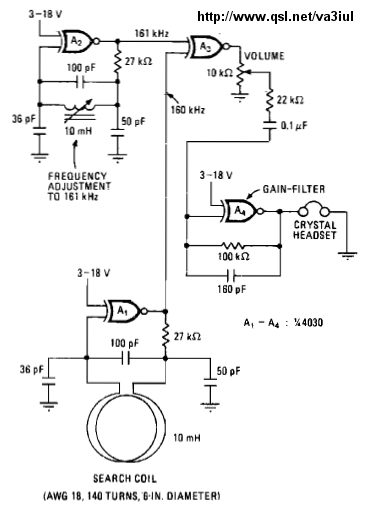
161 kHz Metal Detector - Schematic only __ Designed by va3iul
16-Bit ADC Simplifies Current Measurements - DN341 Design Notes__ Linear Technology/Analog Devices
16-bit adjustable reference uses 8-bit digital potentiometers - 12/25/03 EDN Design Ideas: it may be easy to find a precision voltage reference for your application; however, a programmable precision reference is another matter. The circuit in Figure 1 yields a precision reference with an LSB of 62.5 µV. The circuit is a 16-bit DAC using three 8-bit digital potentiometers and three CMOS
op amps Design by Bonnie Baker, Tucson, AZ
16-Bit Resolution Unidirectional Current Sense into LTC2433 ADC - The LTC2433-1 can accurately digitize signal with source impedances up to 5kΩ. This LTC6101 current sense circuit uses a 4.99kΩ output resistance to meet this requirement, thus no additional buffering is necessary. __ Linear Technology/Analog Devices App Note, Mar 31, 2010
17 Foot Wind Turbine. Part 3. Stator Fabrication. - Continuation The coils for the new 17 foot wind turbine are larger than those for the first 17 footer we made. We actually use exactly the same size and shape of coil that we did for the 20 foot diameter wind turbine. Again -- if you're thinking__
17 Foot Wind Turbine. Part 4. Assembly & Blades - Continuation This page is about the assembly of the alternator. Pictured above we have the back magnet rotor assembled to the wheel hub with all the studs on. The back rotor lays right on the back machined surface of the wheel hub. Again__
1-Cell Monitor with Bottom-Side Sense - The LT2940 measures a high side current and a differential voltage, multiplies them and outputs a current proportional to instantaneous power. Bidirectional high side currents and bipolar voltage differences are correctly handled by the four-quadrant multiplier and push-pull output stage, which allows the LT2940 to indicate__ Linear Technology/Analog Devices App Note, Apr 26th 2010
1-IC Forms Precision Triangular-Wave Generator - 04/08/10 EDN Design Ideas: Generate a triangular wave for testing other circuits. Design by Akshay Bhat, Maxim Integrated Products Inc, Sunnyvale, CA
1Khz to Over 70Mhz Light Receiver - This circuit uses one tiny C-MOS inverter IC to form a modulated light receiver with a very fast response. it is designed around a PIN photo diode that is packaged for use with plastic optical fibers. it can be used as an optical fiber receiver. By using the open end of the optical fiber it can "sniff" out any modulated light signals . . . Hobby Circuit designed by David A. Johnson P.E.-June, 2000
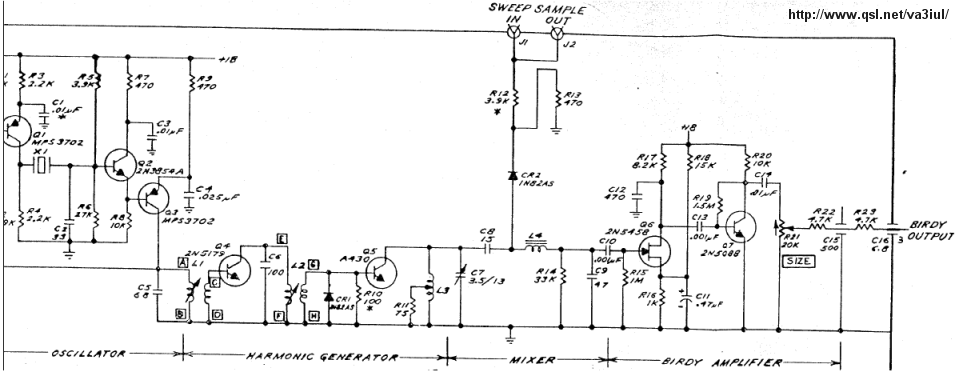
1MHz-step Harmonic Marker Generator - Schematic only __ Designed by va3iul
1-NiMH
Cell powers White LED - There are a lot of white LED driver circuits floating around. A popular circuit called the “Joule Thief” can drive one white LED from a single 1.2v or 1.5v battery cell. Most of these circuits use one or two transistors to form a voltage boost circuit . . . Hobby Circuit designed by David Johnson P.E.-September, 2009
1ppm Settling Time Measurement for a Monolithic 18-Bit DAC - Linear Technology AN120 __ Designed by Jim Williams - Mar 10th, 2010
1-Wire Barometer - This article describes details for constructing a 1-Wire Barometer which will work on a Dallas Semiconductor Corporation 1-Wire network. The reason for this second version is that the transistor level-changer of the original design was found to be temperature sensitive. if you have constructed the original version (V1.0) you can modify it according to the diagram shown below. This involves removing the transistor and 5 resistors, then rewiring it with 6 new resistors. __ Designed by David W. Bray
1-wire barometer - This is a description and the ongoing story of my project to build a 1-wire barometer based on the MPX4115A __ Designed by Philip Gladstone
1-Wire Barometer. Part 1 - This article describes details for constructing a 1-Wire Barometer which will work on a Dallas Semiconductor Corporation 1-Wire network. it differs from the popular Version 1.1a in that it has more than twice the resolution. __ Designed by David W. Bray
1-Wire Barometer. Part 2 - The design presented in the schematic above is not the only possible barometer that can be constructed with this printed circuit board. Not only is the printed circuit board designed to be modified for different voltage sources and 1-wire networks, but the values of the resistors can be modified for different ranges of barometric pressure and resolutions. __ Designed by David W. Bray
1-Wire Barometer. Part 3 - Suggestions on Final Calibration Getting your barometer accuracy calibrated will take adjustment over several cycles of barometric pressure change. The initial calibration will not be accurate unless your MPX4115 has the same output vs pressure __ Designed by David W. Bray
1-Wire Barometer--5/10 Volt Design vrs 2 - This article describes details for constructing a 1-Wire Barometer which will work on a Dallas Semiconductor Corporation 1-Wire network. it differs from the popular Version 1.1a in that it has more than twice the resolution. __ Designed by David W. Bray
1-wire bus powers water-level sensor - 02/15/00 EDN Design Ideas: remotely monitor the level of liquid water in a vessel such as a swimming pool Design by Dale Litwhiler
2 ADC channels double sensor precision - 03/18/99 EDN Design Ideas: (PDF contains multiple circuits, scroll to find this circuit) The accuracy of the onchip ADCs of numerous small and inexpensive 8-bit mPs is well-suited for many applications. However, some situations benefit from. PDF contains multiple circuits, scroll to find this circuit Design by Luke J Barker, Reinke Manufacturing Co Inc,Deshler, NE
2 diodes change Demagnetization-signal polarity - 04/12/01 EDN Design Ideas: Power-supply designers usually like flyback converters to operate in DCM (discontinuous-conduction mode) rather than in CCM (continuous-conduction mode). in DCM, the flyback converter is a first-order system at low frequencies, which eases the feedback-loop compensation. You can use a low-cost secondary rectifier, thanks to soft blocking conditions Design by Christophe Basso, On Semiconductor, Toulouse, Cedex, France
2 GHz Frequency Counter - This simple counter is useful for frequency measurements of various wireless equipments, especially transmitters, receivers and signal generators in VHF/UHF band __ Jan Kolar
2 Nanosecond, .1% Resolution Settling Time Measurement for Wideband Amplifiers - Linear Technology AN128 __ Designed by Jim Williams - Aug 16th, 2010
2 Sensors Measure Three Line Current - 09/01/95 EDN Design Ideas: An old technique updated for modern requirements allows you to measure all three line currents in a three-phase system. You perform this measurement using two current transformers (CTs) and three ammeters. The original technique appeared in Alternating-Current Machines by George Mueller (McGraw-Hill, 1952). The method works equally well with modern current sensors. Figs 1 and 2 illustrate the technique. Design by Henno Normet, Tavares, FL
2 Tests for Crystal - Two simple test circuits to check operation of quartz crystals __ Designed by Andy Collison
2.2-100V Zener Diode Tester - Got a bunch of unknown diodes and zener diodes? Check 'em all with this __ SiliconChip
-20 DB Couplers for use with a with a spectrum analyzer or other sensitive Detector - One of the slickest ways to look at higher powered signal sources with a spectrum analyzer or other sensitive detector, with out running the risk of burning out the front-end, is to employ a -20 dB coupler. This simple device is nothing more than a 10:1 broadband transformer that reduces the power input to the detector by a factor of 100, or -20 dB. Using this device reduces a 1 watt, 20 volt peak-peak signal down to a 10 milliwatt, 2 volt peak-peak signal while maintaining excellent fidelity. __ Designed by Jim Kortge, K8IQY
-20 dBm, 14.060 MHz Precision Signal Source - As many of you know, measuring most receiver parameters requires using two sources, usually offset by 5, 10 or 20 Khz. While one might have a good signal generating source in the lab, having two of them is often prohibitive from a cost stand point. This -20 dBm source can be built for any frequency. However, for my use in measuring the receive strip of my new 2N2/20 transceiver, a second signal source on 20 meters was needed. Since readily available crystals are available from NorCal, and other suppliers, that hardest-to-find of the parts is quite easy to acquire. __ Designed by Jim Kortge, K8IQY
20 MHz to 600 MHz Spectrum Monitor - Schematic only __ Designed by va3iul
20 Segment Expanded Scale Voltmeter - This is an Expanded Scale Voltmeter based on the National LM3914 chip. it is a 0.25 volt range between each LED. __ Designed by G.L. Chemelec
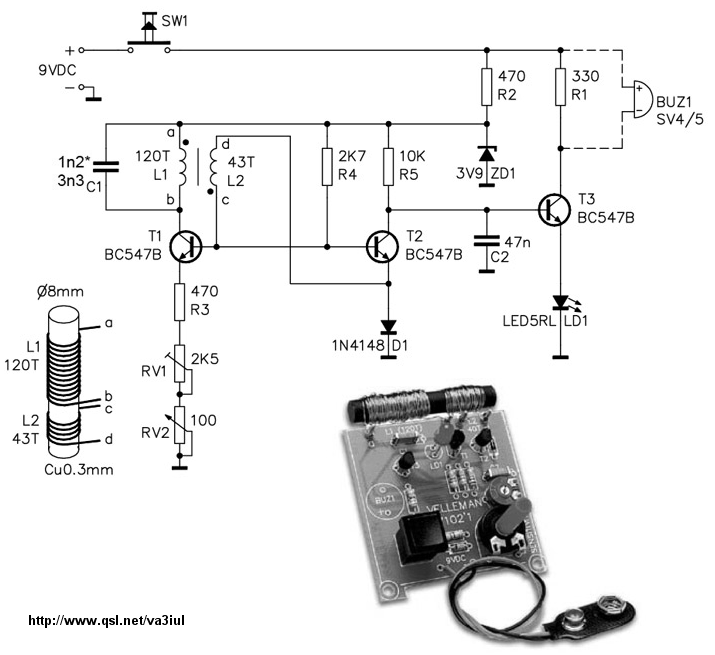
200 kHz Metal Detector - Schematic only __ Designed by va3iul
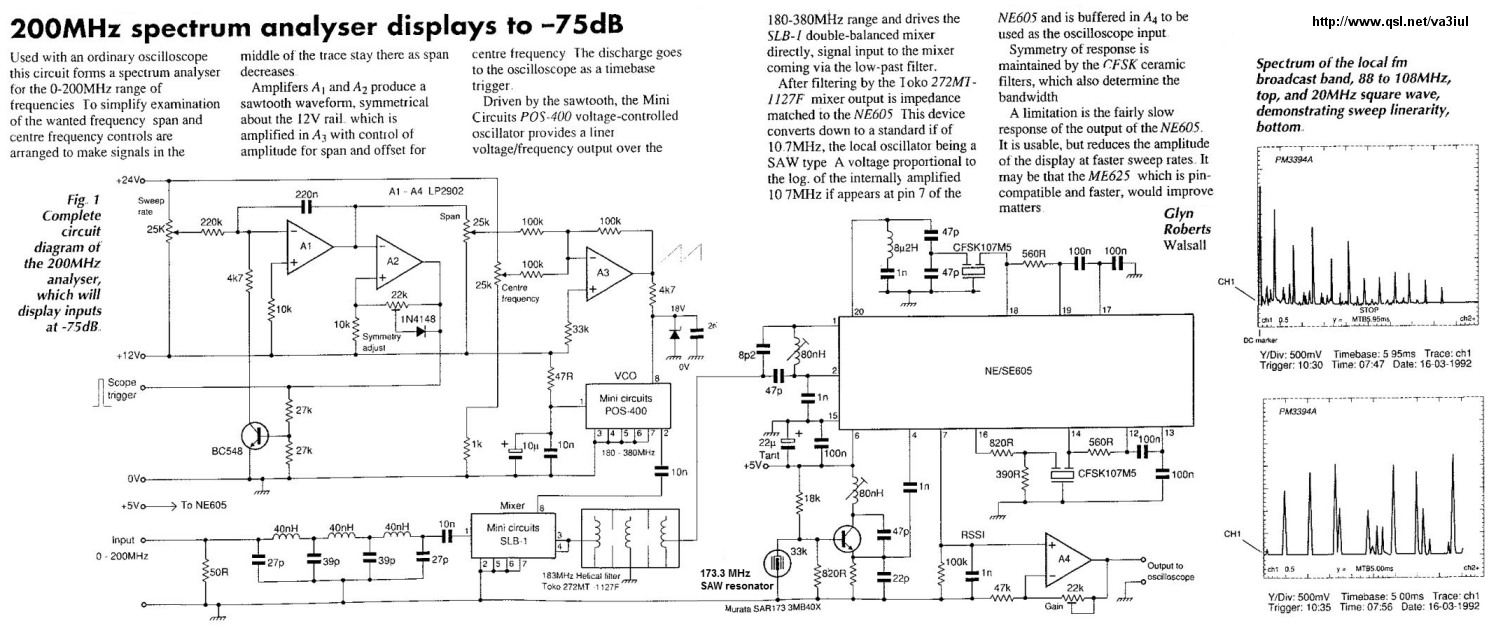
200 MHz Spectrum Analyzer - Schematic only __ Designed by va3iul
20ma Current Loop Tester - A while back I needed to test a circuit at 240vac. Since I needed to safely test the circuit using my oscilloscope, I needed the 240vac to be fully isolated from the power line. So, to step up the voltage, I bought a small isolation transformer from Digikey. . . Circuit by Dave Johnson P.E.-May, 2011
20Mhz VCSEL 3mw Laser Test Circuit - This circuit takes advantage of some new vertical cavity surface emitting lasers (VCSEL) that don’t require light output control circuits. The circuit shows how to drive the device from a single high speed CMOS
IC. . . Circuit by Dave Johnson P.E.-June, 2000
220 Volt Live Wire in Wall Scanner - This little circuit will help you to scanline of a 220V live wire inwall. FET gate is connected to a capacitive metal sensor (which is usually a simple metal plate). When you holdsensor close towall, LED will indicatecurrent flow around where it detectswire. Works on 9VDC __ Designed by Peter Jakab, Electrical Engineer, Engineer of Informatics
|