 |
|
|
|
|
|
Dave Rants & Raves [Issue
2, October 2009]
Previous Issues
|
|

|
Electrodeless Fluorescent
Lamps
By: Dave Johnson |
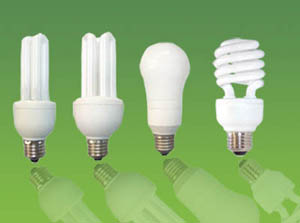
| Compact fluorescent lamps are
quite popular these days. They can offer more light for less power when compared to
standard incandescent lamps. When made by quality companies, they can also outlast
standard lamps. But, many of the lamps coming out of China are poorly made. Very few of
the lamps I have purchased lately have lasted more than two years, even when the package
says that the lamp would last 5 years. I’m sure many of you have had similar experiences. |
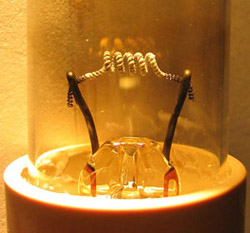
| The weakest part of a standard
hot cathode fluorescent lamp is the cathode itself. Over time the hot cathode electrode
weakens and will fail, killing lamp operation. Frequent on/off cycling of the lamp
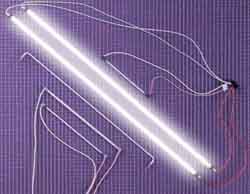
will further weaken the cathode. Cold cathode lamps, which don’t have hot cathodes and are
often found in laptop computer screens, have much longer lives. I have one laptop
that is over 10 years old and its screen is still just as bright now as when it was new.
But, sputtering action inside those lamps eventually will cause enough of the metal from
the cathode electrodes to be deposited inside the lamp, obscuring the light.
|
 |
 |
 |
| Compact Fluorescent Lamps |
Fluorescent Lamp Cathode |
Cold Cathode Fluorescent Lamps |
|
| But, what if you could do away
with the metal electrodes completely? Then, the lamp should last much longer.
The only thing that will eventually fail in such a lamp would be the control electronics
and perhaps over time, the phosphors inside the lamp will fade. A 10 year life might
be possible. My definition of the end of life is when the light output drops by 50%
of the original intensity. |
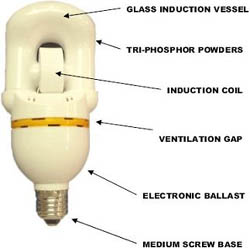
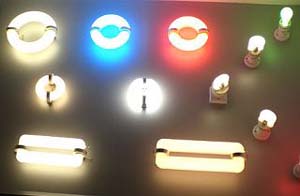
| I’m now beginning to see some
of these new “electrodeless” lamps being promoted. The lamp uses much of the same
mixture of gases, phosphors and a tiny bit of mercury as in the conventional lamp, but
they have no metal electrodes at all. To excite the gasses inside, a magnetic
induction method is used. This is basically a toroid shape transformer with the
glass tube of the lamp forming a single turn secondary. A high frequency magnetic
field produced in the center of the coil induces enough current to flow in the lamp to
cause it to glow brightly. There is not much data yet on the overall efficiency or
brightness of these devices but I expect them to be close to that of a conventional hot
cathode lamp. In applications where lamp life if more important than brightness, I
expect these to outshine most any other type of lamp, including LED lamps. |
 |
 |
| Electrodeless
Fluorescent Lamp |
|
|
|
|
|