|
A high-quality narroW band FM Transceiver for 2.3 GHz - (Right now the transceiver is only a receiver, I deceided to finish the transmitter somewhen in the future. The RX part is working very well and the documentation is pretty complete. (Schematics, concept descriptions, pictures, etc.) __ Designed by Herbert Dingfelder
A Low Power RF ID Transponder - This is the Grand Prize winner in the design category of the 1993 RF Design Awards Contest. This entry exhibited both innovative use of RF technology and an elegant implementation of that technology __ Designed by Raymond T. Page, Reprint courtesy of RF Design Magazine
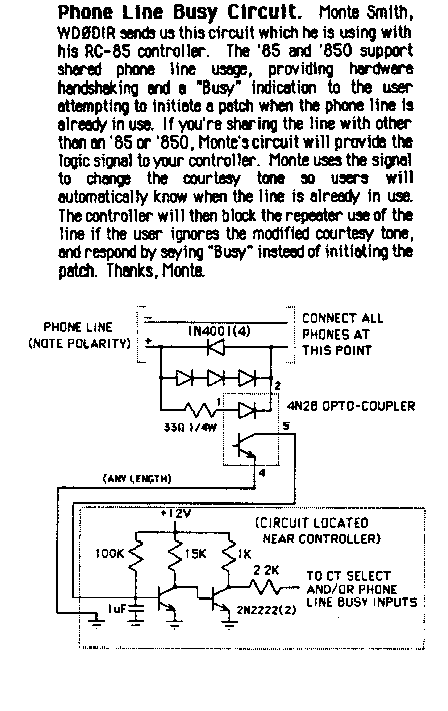
A Phone Line Busy Sensing - If you need to share a phone line between your home and a repeater, here's how. __ Designed by Monte Smith, WDØDIR, from ACC Notes, April, 1986.
A Photo Tour of a Bird Wattmeter Element - Ever wonder what's inside one of those elements? __ Designed by Robert W. Meister WA1MIK
A Poor Ham's Deviation Meter - A theory and practice article on measuring deviation of FM transmitters, __ Designed by Robert W. Meister WA1MIK
A Precision Portable Voltage Reference - It has been said that a man with one watch knows what time it is, but a man with two watches is never sure. The same can be said for a person who has more than one voltmeter. In my situation, I have several voltmeters in each of two different locations a third of the way around the world apart. The best solution would be to send the meters to NIST traceable calibration labs, __ Designed by Dick Cappels
A purpose-built MotrAC Metering set - I needed to tune a Motrac-based Compa-station but had no official metering set. I had a meter; I bought everything else. You can modify the design to suit your needs. __ Designed by Robert W. Meister WA1MIK
A Repeater Fan Controller using a 556 IC - This is a follow-up to the above with a modification to a single 556 chip. __ Designed by George Henry KA3HSW
A SCA Adapter - For Advertisement Free Background Music on FM. __ Designed by G.L. Chemelec
A Simple Circuit audio mute - 20 kB PDF file. If you're using discriminator audio and need to mute it, this circuit will do the job. Sent anonymously to repeater-builder.
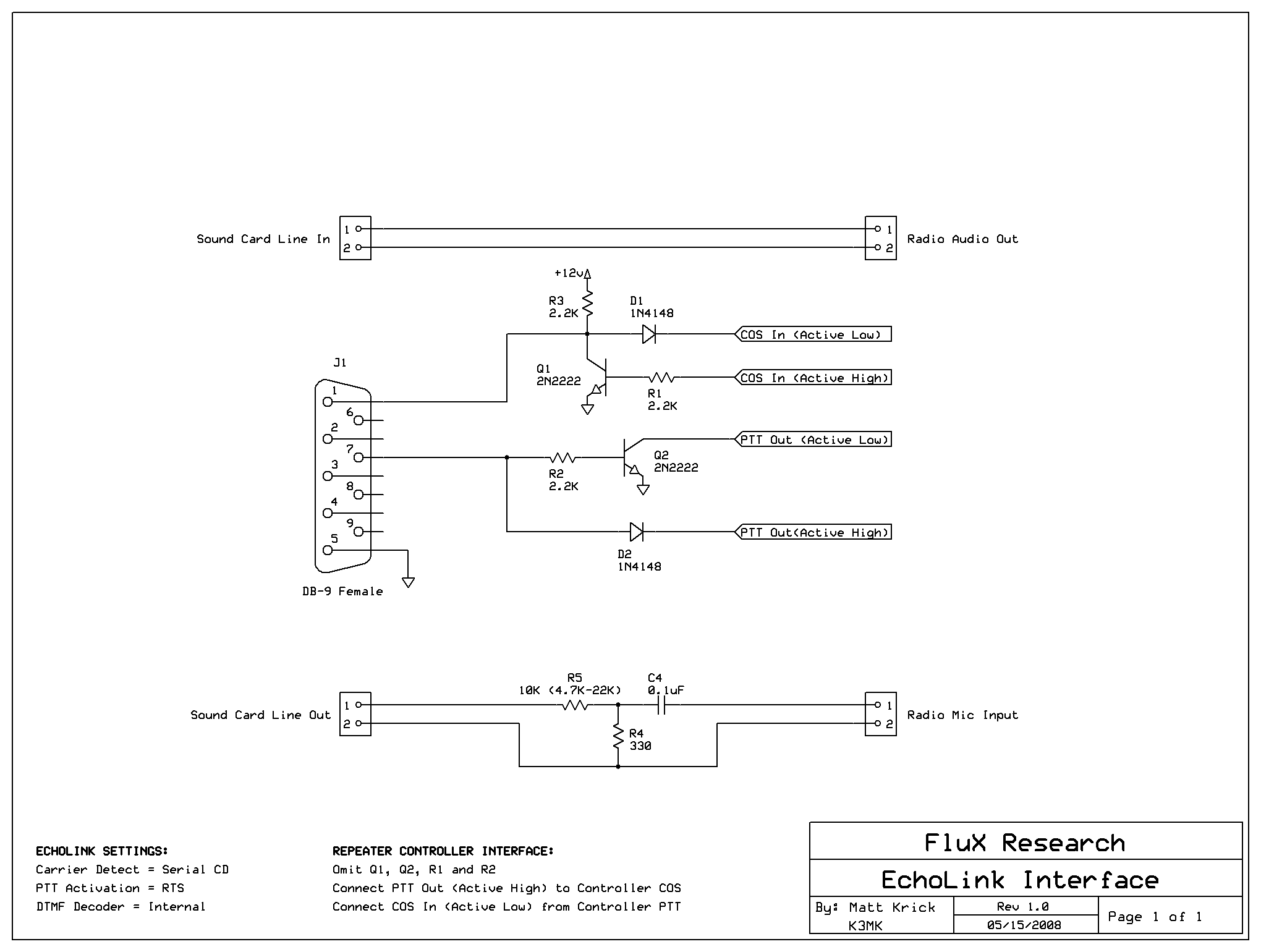
A Simple Circuit Echolink interface - Easily constructed with about $10 in parts from Radio Shack. Should work with any radio. __ Designed by Courtesy of Matt Krick K3MK
A Simple Circuit Repeater Fan Controller - Unlike many repeater systems, our local club repeater has always been located within a member’s home, many times in a basement or in this case, my home office area. The latter created a desire to lower the noise level generated by the repeater, specifically, the power amplifier cooling fans. __ Designed by Robert Shepard KA9FLX
A small FM transmitter (SMD) - This SMD FM transmitter has an operating frequency of about 80 to 115MHz. Under reasonable circumstances you will be able to receive its signal at a distance of about 200 meters. Although it is low-power, it might be illegal in your part of the planet.
A SSB/FM Receiver for 144 MHz (my graduation thesis) - (This one is very detailed, including all schematic diagrams) __ Designed by Herbert Dingfelder
A Superhet/Direct Conversion AM receiver for 181.818 kHz - This is a description of an experimental AM receiver for VLF. It is crystal controlled to receive 181.818 kHz (more or less) and operates as either a single conversion superhetrodyne or a direct conversion receiver. The bandwidths are expected __ Designed by Dick Cappels
A Tone Beep Keyer for Repeaters - Obtain an Audible Indication of Off-Frequency Operation. __ Designed by Originally Art Gentry W6MEP. Reprinted from May 1974 QST.
A universal serial PC interface Module - The circuit consists basically of a AT90LS4433 AVR processor and a RS232 level shifter. Together with the software this forms a interface to your PC with digital inputs and outputs and 10bit-ADC inputs. Can be accessed via any terminal program or with your own homemade software. Nice to have for everyone that wants to control or measure something with a PC. __ Designed by Herbert Dingfelder
A VHF/UHF/LINK repeater interface/controller - This is a set of nearly identical schematics for circuitry used to provide cross-band inter-agency communications.
Active antenna 1 to 20dB, 1-30 MHz range - When fate or nasty neighbors prevent you from stringing a long-wire receiving antenna, you'll find that this pocket-size antenna will give the same, or even better, reception. This "Active Antenna" is cheap to build" and has a range of 1 to 30Mhz at between 14 and 20dB gain __ Designed by Tony van Roon & Rodney A. Kreuter
Active Antenna AA-7 HF/VHF/UHF, 3-3000MHz - If you have a shortwave or high-frequency receiver or scanner that is struggling to capture signals with a short, whip antenna, and you'd like the kind of performance that a 60-foot 'longwire' antenna can provide but lack the space to put one up, consider building the AA-7 HF/VHF/UHF Active Antenna described in this article. __ Contact: kangyono99 @ yahoo.com
Active Antenna Experiments - Many builders emailed me requesting a simple, broadband VPA (voltage probe antenna) design with more power gain than the common gate versions I have presented elsewhere on this web site. Connecting a whip antenna to a cascode JFET stage described by W7ZOI in Experimental Methods in RF Design is 1 method I considered. __ Designed by Todd, VE7BPO
Active Antenna, easy to build - When fate or nasty neighbors prevent you from stringing a long-wire receiving antenna, you'll find that this pocket-size antenna will give the same, or even better, reception. This "Active Antenna" is cheap to build" and has a range of 1 to 30Mhz at between 14 and 20dB gain __ Designed by Tony van Roon & Rodney A. Kreuter
Active FM Antenna Amplifier - This simple little circuit can be used for AM, FM, and Shortwave (SW). On the shortwave band this active antenna is comparable to a 20 to 30 foot wire antenna. It is further more designed to be used on receivers that use untuned wire antennas, such as inexpensive units and car radios __ Designed by Tony van Roon VA3AVR
Active RF antennuator - This active attenuator works as a simple mixer. A signal from a 1 MHz oscillator is mixed with the received signal in a 1N914 diode. The 1000 ohm potentiometer adjusts the level of the local oscillator fed to the mixer diode. __ Designed by Joe Leggio WB2HOL
|