|
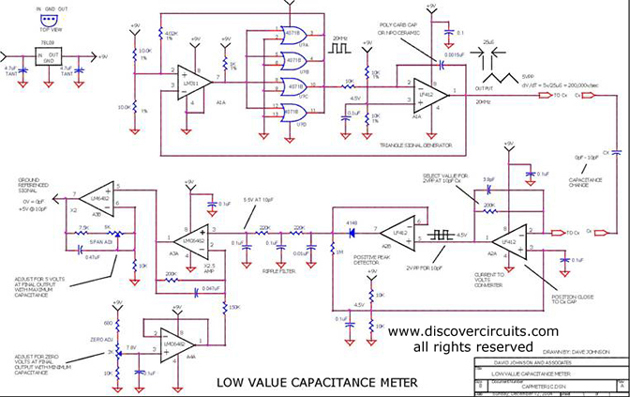
This circuit was originally designed to
measure the volume of the fluid inside a 10cc syringe. It used two copper
foil strips attached to the outside barrel of the syringe. The fluid
between the two copper strips increases the capacitance. As the fluid volume
decreased, the capacitance also decreased. With the circuit shown below, it
is possible to calibrate the circuit, so the voltage produced is
proportional to the fluid volume inside the syringe. With the values shown,
the circuit produces a 5v DC output, when the 10cc syringe is full. It is
possible to measure the fluid volume to a resolution of 0.01cc. The circuit
can also be adjusted to produce a 5v DC output voltage for a capacitance of
10 picofarads to a solution of 0.01 picofarads.
The circuit measures the unknown capacitance
by applying a clean 20KHz 5v peak to peak triangle signal to the capacitor.
The current routed through the capacitance is sent to a current to voltage
converter. The voltage that emerges is therefore a 20KHz square wave signal,
whose amplitude is proportional to the capacitance. The signal’s peak
amplitude is rectified and filtered to produce a DC voltage. Additional op
amps provide a means to adjust the zero and span of the circuit, so a fixed
change of capacitance will produce a known voltage change. A fixed 9v DC
supply powers the complete circuit. |