|
 |
Circuits designed by David Johnson, P.E.
Last Updated on:
Saturday, December 23, 2017 03:21 PM
List of Dave's Circuit Designs
The contents & graphics
of Discovercircuits.com are copyright protected.
LINKING to Dave's circuits is permitted but DO NOT COPY any files to your WEB
SITE server |
|
|
|
|
More
Remote Control;
Television Circuits VCR TV Remote Range Extender
Circuit
I often get frustrated by how poor some
infrared remotes in many new electronic devices operate. I used to be able to
turn on the TV from 30 feet away. Now, it seems that I have to get within 15
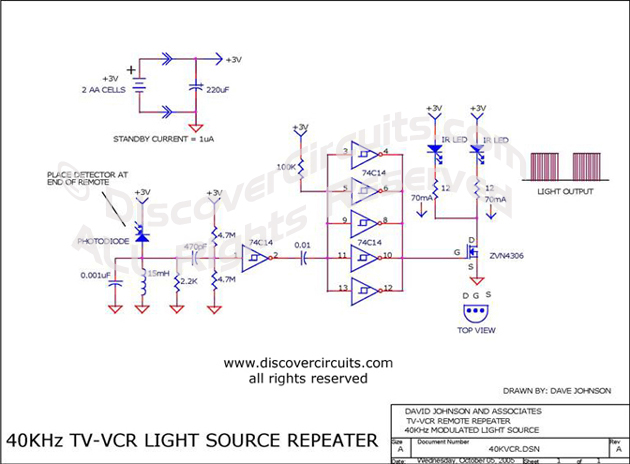
feet. To address this issue, I designed the circuit shown below. The
circuit taps into the TV remote’s existing infrared LED and drives 8 more efficient
devices. The result is a communications range some 4 to 5 times longer.
|
|
| The circuit is
housed in a low profile plastic box. A Serpac H-65AA (Digikey part number SRH65-11B)
has a nice battery compartment for two AA cells. The circuit is powered by two
standard AA cells. I suggest including a 1.5 farad supercapacitor in parallel with
the battery to help supply the peak current needed by the 8 LEDs. A Nesscap
EMHSR-0001C5-005R4 has a very low internal resistance and a higher 5.4v voltage rating.
Other supercapacitors might also work. Just make sure they have a voltage rating
higher than 3v. The recommended infrared LEDs are made by Vishay, their part number
TSAL6100. These are available from Mouser, Mouser part number 782-TSAL6100.
These devices emit infrared light in the longer 950nm wavelength, which most infrared
remote receivers expect. |
| When the VCR
remote’s LED turns on, there is a voltage drop of about 1.5v. This voltage is
sufficient to turn on the PNP transistor Q1. When Q1 is switched on, 3v is routed to
the gate of Q2, which switches it on hard. It routes current to all 8 of the Vishay
LEDS. With a 22 ohm resistor wired in series with each LED, the peak current is set
at about 60ma. This is about 4 times higher than most LEDs are driven in a typical
remote. By wiring 8 more LEDs to form a cluster, the range of the remote should
increase by a factor of least 5. So, instead of 15 feet, with the added light, the
distance should be closer to 75 feet. |
| |
|
Click
on Drawing Below to view PDF version of Schematic |
|
 |
|
|
|
|
|
|