|
9v Powered Xenon Photoflash Controller- This 9v battery powered circuit is designed for remote control flash needs. A charge control circuit turns off the high voltage generator when the photoflash capacitor is fully charged. A neon lamp is included to indicate when the system is ready to flash. . . Circuit by David Johnson P.E.-June, 2000
A doozy requiring some parts you can't get at the 'Shack.- You can make a doozy of a xenon strobe using the 12 volt DC in, DC output mercury lamp ballast here at http://www. don Klipstein. com/ebdc12. html. You may run into a problem with the flashtube arcing continuously after a flash. If you use an open-collector comparator such as a 339 in the overvoltage sensing section of this circuit, you can wired-AND the comparator output with some sort of scheme to disable the circuit for a few to a few tens of milliseconds after a flash ( by "pulling down" Pin 5 of the 555). __ Designed by Don Klipstein
A mad idea for a blacklight strobe- CAUTION - May be both hard on your eyes and a bit disappointing __ Designed by Don Klipstein
A Practical Guide for Successfully Implementing Flash lamps- Linear Technology AN95 __ Designed by Jim Williams - Mar 1st, 2004
A repetitive trigger- Based on the 555 timer IC, useful for strobe lights. A bit on the 4017 counter IC for multiple flashes and sequences of flashes __ Designed by Don Klipstein
Adjustable Strobe Light- This Adjustable Strobe Light is the bigger brother of the plain old strobe light. This one uses a much more powerful "horse shoe" Xenon tube which produces more light. You can also control the flash rate up to about 20Hz. Do not look directly at the flash tube when this thing is on! __ Designed by Aaron Cake
Amplifier for a Xenon Lamp Flash Detector - This circuit has a very low standby current requirement yet has very high sensitivity toward the light flashes from a xenon lamp. When connected to a flip/flop it can serve as an on on/off Controller. . . Circuit by David Johnson P.E.-February, 2002
AN95 - Simple Circuitry for Cellular Telephone/Camera Flash Illumination: A Practical Guide for Successfully Implementing Flash lamps- Linear Technology AN95 __ Designed by Jim Williams - Mar 1st, 2004
Beat Tracking Strobe- Strobe lights have always been an integral part of dance parties, adding an additional element of excitement to the festivities on hand. The combination of flashing lights and music-especially those with a definitive strong beat- are a natural complement to one another, where the strobing of light is an extension and links one's aural perception to his visual senses. The applications of strobe lights are numerous. In more involved and comprehensive applications the strobe user would like the strobe to help fuse together the music and light. For our final project we opted to attempt to create such a strobe system appropriate for the more complex application by creating a light strobe system that flashes a light source directly in sync with the music in real time __ Designed by Chris Chan and Kenneth Liu
Build Your Own Popcorn Strobe- Mini 555 Monostable circuit creates big fun. __ Contact Jameco Electronics
Capacitance Touch Switch- A single 1.5v silver oxide button cell powers this complete touch activated switch circuit for 5 years. It features both a normally open and a normally closed set of solid state switch thermals. It also has an adjustable sensitivity, which can be set . . . Hobby Circuit designed by David Johnson P.E.-January, 2002
Controller for a 9v Powered Xenon Photoflash- This 9v battery powered circuit is designed for remote control flash needs. A charge control circuit turns off the high voltage generator when the photoflash capacitor is fully charged. A neon lamp is included to indicate when the system is ready to flash . . . Hobby Circuit designed by David Johnson P.E.-June, 2000
Detect Short Xenon Lamp Flashes- This circuit uses a small 2.5mm square photo diode in conjunction with a 100mH coil to detect the short light flashes from a xenon lamp. The coil makes the circuit immune to normal room lights. Its 10mv sensitivity can detect light flashes from a range of over 100 feet. . . . Hobby Circuit designed by David A. Johnson P.E.-February, 2002
Detects Xenon Lamp Flash- This circuit has a very low standby current requirement yet has very high sensitivity toward the light flashes from a xenon lamp. When connected to a flip/flop it can serve as an on on/off Controller . . . Hobby Circuit designed by David A. Johnson P.E.-December, 2004
Doozy requiring some parts you can't get at the 'Shack.- You can make a doozy of a xenon strobe using the 12 volt DC in, DC output mercury lamp ballast here at http://www com/ebdc12. html. You may run into a problem with the flashtube arcing continuously after a flash. If you use an open-collector comparator such as a 339 in the overvoltage sensing section of this circuit, you can wired-AND the comparator output with some sort of scheme to disable the circuit for a few to a few tens of milliseconds after a flash ( by "pulling down" Pin 5 of the 555). __ Designed by Don Klipstein
DUAL- COLOUR STROBOSCOPE- Stroboscope is a device used to make a cyclically moving object appear slow-moving or stationary. This is realised by illuminating the object intermittently with short pulses of light. Stroboscope is used in the study of insect flight. It can also be used for experiments with simple pendulum, studying details of rapidly moving objects and strobe-animation.__ Designed by Raju Baddi
Emergency strobe flasher generates 250V- 08/05/99 EDN Design Ideas: Figure 1 shows a complete circuit for an emergency lamp that operates from a 12V automotive battery. The xenon flash tube requires a 250V-dc anode voltage and a 4-kV trigger pulse. To generate the 250V dc, IC1, Design by Jose Luis Arce, Tecnosuma Havana, Cuba
Flash Slave Trigger- Flash slaves are used when you need to supplement1-flash unit with1-or several more. This slave trigger simply triggers those other units. It does this by "seeing" the first flash ( using a phototransistor) and triggering the other flashes a few microseconds later. The sensitivity of the circuit is adjustable to compensate for ambient light or dimmer than usual master flashes. __ Designed by Aaron Cake
Flashing Beacon- A flashing beacon has many uses. It can be employed as a distress signal on highways or as a direction pointer for parking lots, hospitals, hotels, etc. Here we present a...__ Electronics Projects for You
Flashing High Intensity LED 3rd Brake Light- This circuit to make a flashing 3rd brake light assembly was designed to be easy to locate all the needed components and reasonably in expensive to build__ National Semiconductor
Flashing Indicators- Need to flash "turn indicators" using a 555 and a single 20 amp relay. Here is our suggestion. The timing resistor needs to be selected for the appropriate flash-rate. __ 555-Timer
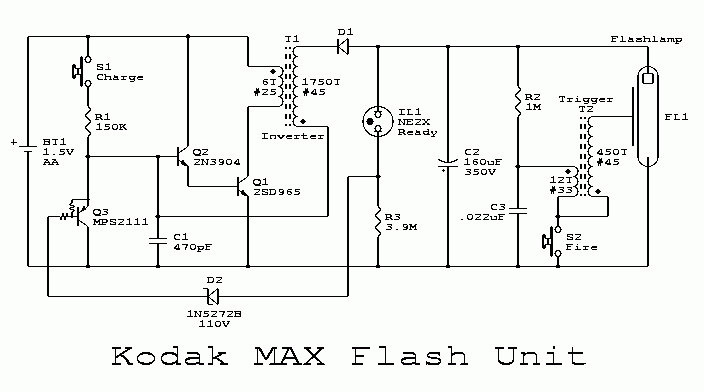
Hacking the Kodak Max Single Use Flash Camera into a Self-Repeating Strobe- NOTE - this approach is recommended mainly for Homebrewing a strobe that is powered by a single 1.5 volt battery. If you can use a higher supply voltage, there are better ways to do this. __ Designed by Don Klipstein
Kodak Max flash unit- Schematic for the Kodak Max flash unit __ Designed by Don Klipstein |