|
Car anti theft wireless alarm - This FM radio-controlled antift alarm can be used with any vehicle having 6to 12-volt DC supply system. The mini VHF, FM transmitter is fitted in vehicle at night when it is parked in car porch or car park. The receiver unit with CXA1019, a single IC-based FM radio module, which is freely available in market at reasonable rate, is kept inside. Receiver is __ Designed by Radioland.nt.au Circuit uses Simple Circuit LED for near-IR light - 09/01/98 EDN-Design Ideas NOTE
: File has many circuits, scroll down. You can successfully use LEDs as sources of near-infrared light. However, when you need a source of light with precisely controlled power, a feedback loop is necessary to compensate for the temporal and thermal changes of the LED parameters. Standard LED types come with neither these monitoring detectors nor an external monitoring photodiode to detect part of the emitted light and generate a feedback signal. The situation calls for some mechanical fixture to mount the photodiode. Design by Lukasz Sliwczynski, Marcin Lipinski, Institute of Electronics, Krakow, Poland
Color Film Makes Optical Filter - This isn’t an electronic circuit but the file shows the curve for an optical filter made from exposed color film. The material blocks most visible light but is very transparent to 880nM infrared light. Kodak 100ASA is exposed to "cool white" fluorescent light for about 5 seconds. . . Circuit by Dave Johnson P.E.-January, 1998
Computerized Infrared Remote - control your stereo, TV and VCR from Windows, includes schematic and software
Decoded IR Toggle Switch using the PIC12F629 - The circuit above illustrates using the IR receiver module along with a PIC12F629 microcontroller to decode 5 individual IR remote control keys so the circuit will only toggle one of the 4 outputs when a particular key is pressed. The 5th key is assigned to the master clear function that toggles off the 4 outputs. Works with most hand held IR remote controls that send a single data stream. However, some remotes send multiple groups of data and only the first set of 40 bits or less will be recognized. __ Designed by Bill Bowden
Designing an AM Receiver for Low Power Wireless Systems using the NEC UPC2768GR IC 7/22/96 - App Note Doc #921__ California Eastern Laboratories
Detects Shadow Activated Motion - This circuit can sound an alarm when the shadow of a hand or arm moves over two small photo diodes. . . Circuit by David A. Johnson P.E.-August, 2005
Digibox Interface - Schematic only __ Designed by Derek Ellis
Direction sensing Motion Detector - Detects motion and indicates the direction that a human or animal is moving (left or right) .12 pages. This project is not available as a kit of parts. __ Golab.com
Dual PICAXE Infared Data Communication - What's this? Twin Picaxes? Is this Stan's idea of an April Fools Day Joke? Maybe he's just seeing double __ SiliconChip
Entry Alarm - This is an Infrared based Broken beam alarm to protect doors and entry passages. It gives a loud alarm when somebody crosses the Invisible Infrared barrier. It can protect the doors both day and night and is free from false triggering. The circuit is too simple and can be a good evening project for the hobbyists. The circuit __ Designed by D Mohankumar
Finger Touch Activated Switch - It does not get any easier if you want a solid state switch that is activated by the touch of a finger. Two small metal pins route voltage through the finger skin to a MOSFET switch. The circuit is great for situations where a membrane type mechanical switch. . . Circuit by David Johnson P.E.-June, 2000
Fire Stick Infrared Remote Control - This article will show you how to build your own version of the Fire-Stick infrared remote control system. The Fire-Stick has been an extremely popular, and HOT selling item here at Rentron. com for quite a long time. The LITEON infrared receiver modules originally designed-in to the Fire-Stick have been discontinued, and forced us to re-design the original circuit boards. __ Designed by Reynold's Elec
Four-Channel Remote Control - You can construct your own long range infrared (IR) wireless remote using Motorola's MC145026 emitter and MC145027 detector chips. With your remote you can control devices up to 20 feet (7 meters) away. It operates similiarly to a TV remote. You just point the emitter at the detector, push a transmit button. The detector then interprets your data signal. You can use this circuit to remotely turn on/off devices (like a motors, relays, home appliances) . __ Designed by Boondog web site
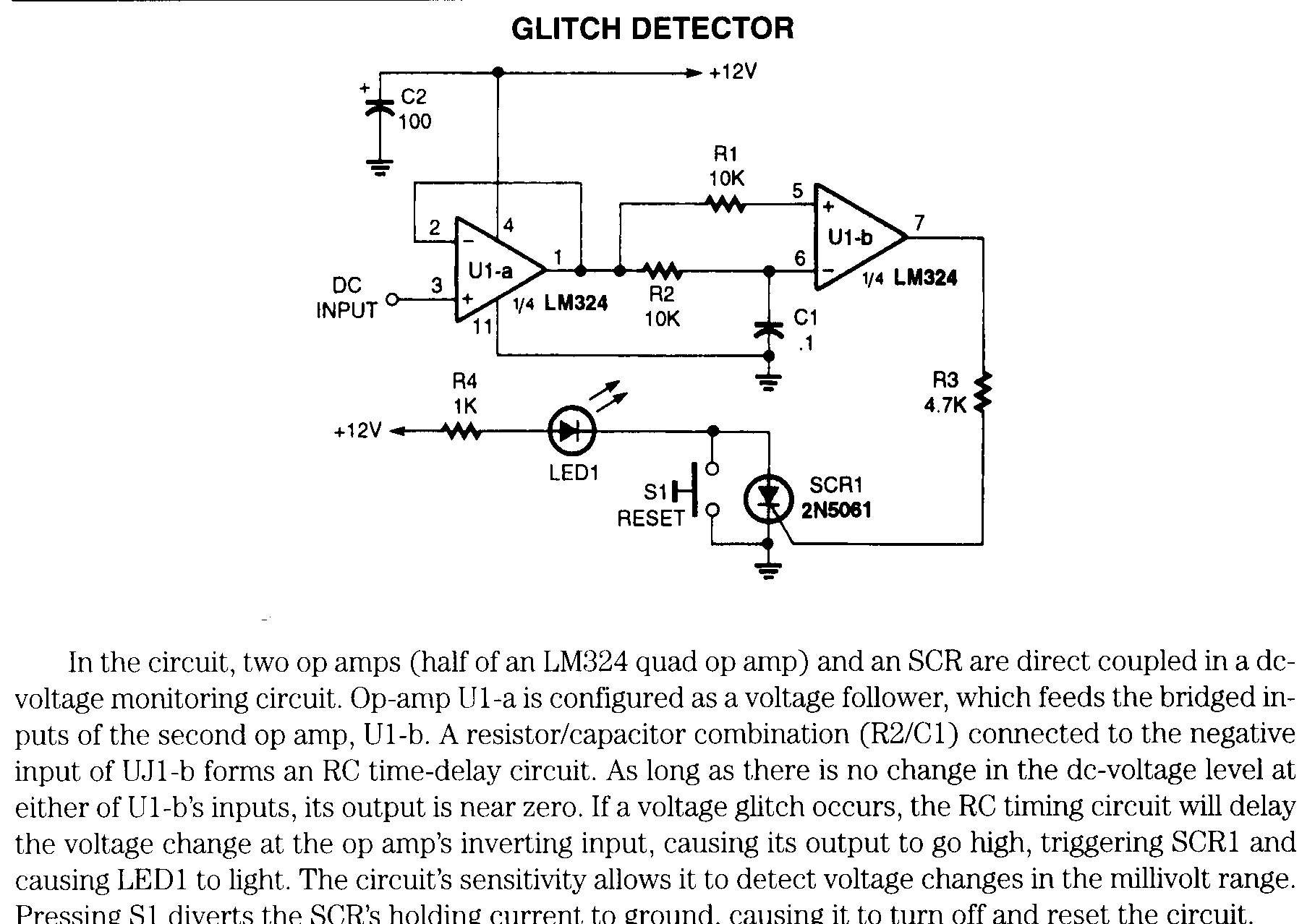
Glitch Detector - In the circuit, two op amps (half of an LM324 quad op amp) and an SCR are direct coupled in a de-voltage monitoring circuit. Op-amp U1-a is configured as a voltage follower, which feeds the bridged inputs of the second op amp, Ul-b. A resistor/capacitor combination (R2/C1) connected to the negative input of U1-b forms
Good IR Detector - How to build a simple IR detector, schematics and alternate links __ Designed by DC Reagan
High Performance Receiver for Wireless Applications - App Note Doc #904 1/16/94 __ California Eastern Laboratories
Homebuilt night vision scope - Here I made an infrared viewer (night vision scope) from mostly crap out of the trash. I did have to buy the main component, the image intensifier tube, because I think it's pretty unlikely that I'll come across one in the dumper. __ Designed by Greg Miller
HP48SX IR DeCODER - ASCII Drawing |